Livestock Mothers and Children Cliparts: A Designer's Best Friend
Understanding the Heart of This Collection
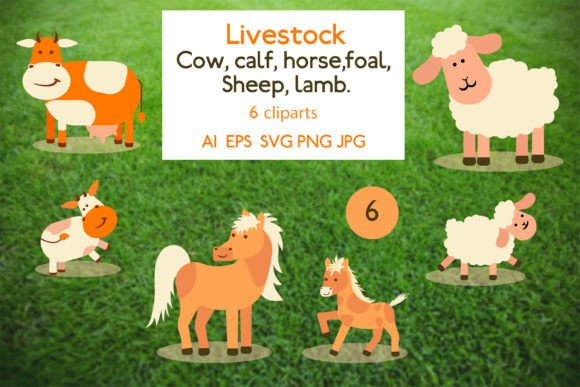
There’s a certain warmth that comes with the imagery of a mother cow and her calf, or a ewe standing protectively over her lamb. This is precisely the emotional core captured in the Livestock. Mothers, Children. Cliparts set. It’s not just a random assortment of farm animals; it is a curated narrative of nurturing and growth. The collection features six distinct vector illustrations: a cow and calf, a horse and foal, and a sheep and lamb. Rendered in a clean, flat style, these graphics strip away unnecessary noise, focusing on solid shapes and clear lines. This minimalism is intentional. It allows the personality of the animals—the gentleness of the mare, the curiosity of the foal—to shine through without getting bogged down in photorealistic textures. For a designer, this means you have assets that are immediately recognizable and emotionally resonant.
The "flat style" mentioned in the description is a crucial detail for modern application. We are well past the era of heavy drop shadows and 3D bevels in web and app design. Today’s modern typography and layout trends favor flat design because it loads faster on websites and scales better across devices. These cliparts fit seamlessly into that environment. Whether you are building a brand identity for a local organic farm, a children’s educational app, or a sustainable clothing line, the visual language here is versatile. It doesn't scream "stock photo"; it whispers "custom illustration." The 5000x5000 pixel resolution ensures that even if you need to crop in tight on a specific animal for a logo design or a packaging design element, the edges remain crisp and professional.
Practical Applications: From Screen to Print
One of the biggest headaches for content creators is asset compatibility. You find the perfect graphic, but it only comes in a low-res JPEG, or the background won't remove cleanly. This set eliminates that friction by providing five formats: AI, EPS, SVG, PNG, and JPG. This is the industry standard for a reason. If you are working in Adobe Illustrator or Affinity Designer, the vector files (AI, EPS, SVG) allow you to change colors instantly to match a specific brand identity palette. Need a brown horse to be a dapple grey? Done in seconds. This flexibility is what separates amateur projects from professional design.
For those working on digital projects, the PNG files with transparent backgrounds are invaluable. Imagine you are a blogger writing about spring farming or a marketer creating social media graphics for a veterinary clinic. You can drag and drop these mothers and children directly onto a photograph or a solid color background without worrying about that tell-tale white box around the edges. The 300 DPI resolution is equally important for print. If you are designing wedding invitations for a rustic barn venue, greeting cards, or scrapbooking layouts, these files will hold up beautifully on paper. The high resolution ensures that the ink sits cleanly on the page, avoiding the pixelation that plagues lesser assets.
Strategic Design and Brand Perception
Using imagery like the Livestock. Mothers, Children. Cliparts does more than just fill space; it communicates values. In visual hierarchy, these illustrations act as focal points that convey safety, tradition, and organic quality. If you are a small business owner selling cheese, wool, or farm-to-table produce, these graphics instantly build trust. They signal "authenticity" to the viewer before they even read a word of your copy. This is where visual hierarchy meets psychology. You are using the creative font of illustration to tell a story of care and quality.
However, as with any premium font or high-quality asset, context is key. These cliparts have a specific personality—friendly, soft, and pastoral. They might not be the right fit for a corporate law firm or a heavy industrial manufacturer. Evaluating project fit is about matching the tone of the asset with the tone of the message. When pairing these images with typography, look for typefaces that complement rather than compete. A sturdy sans serif font can provide a clean, modern contrast to the organic shapes of the animals, while a script font or handwritten font can amplify the rustic, artisanal feel. Avoid overly aggressive or geometric typefaces that might clash with the soft curves of the livestock.
Finalizing Your Workflow
When integrating these assets into your workflow, think about consistency. If you are creating a series of social media graphics, try using the cow and calf for one week’s theme and the sheep and lamb for the next. This creates a cohesive visual thread that aids in audience recognition. For editorial design, such as a children’s book or a magazine layout, these illustrations can break up large blocks of text, making the reading experience more enjoyable. They serve as visual anchors that guide the reader's eye down the page.
Ultimately, the value of the Livestock. Mothers, Children. Cliparts lies in their utility. They are not just pretty pictures; they are design assets built for the realities of modern production. Whether you are a crafter making stickers for an Etsy shop or a designer building a website for a client, having access to high-resolution, vector-ready files saves time and money. It allows you to focus on the creative problem-solving aspects of your work—layout, color theory, and messaging—rather than wasting hours trying to fix a jagged edge or remove a background. This collection is a practical toolkit for anyone looking to add a touch of nurturing, natural charm to their next project.